Do You Need 10,000 Steps a Day? Here’s What the Science Actually Says
Updated: 3 days ago
For years, 10,000 steps a day has felt like the number.
Your watch celebrates it. Your fitness app reminds you about it. Maybe you've even found yourself walking around the kitchen at 9:45 p.m. because you're sitting at 9,327 and suddenly going to bed feels like admitting defeat.
But here's the interesting part:
10,000 steps was never established as the magic number for good health.
And some of the newer research on daily steps is actually much more encouraging—especially if 10,000 has always felt like a lot.
So, how many steps do you really need?
Let's look at where the number came from, what researchers have discovered since, and how you can use a step goal without allowing it to become another wellness rule you feel like you're failing.
Where Did 10,000 Steps Come From Anyway?
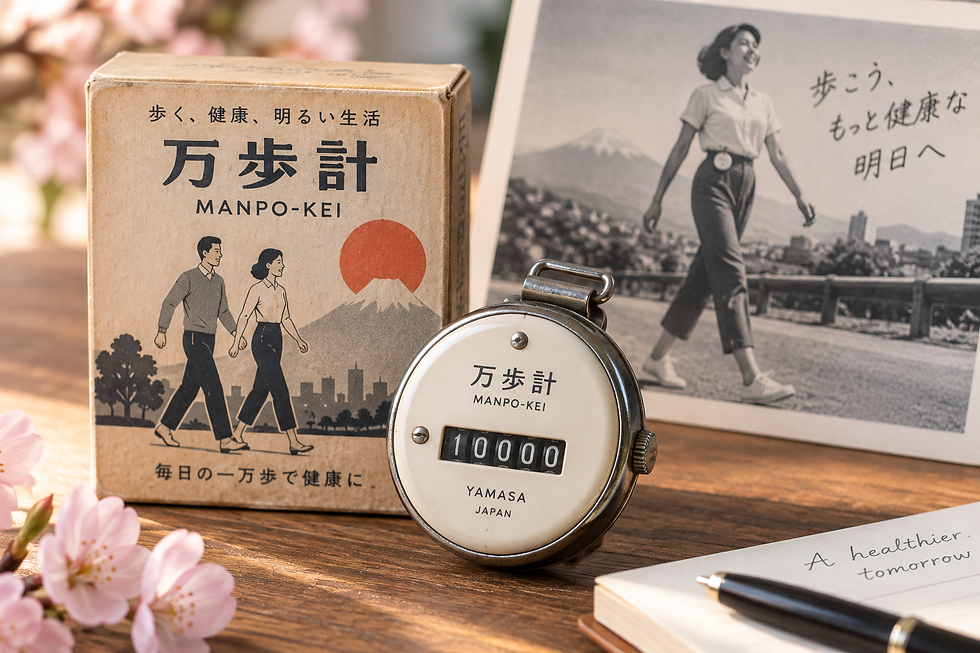
This is one of my favorite pieces of wellness history because it's not what most of us would expect.
The 10,000-step goal appears to trace back to a Japanese pedometer sold in the 1960s called the Manpo-kei, which translates roughly to “10,000 steps meter.” Researchers discussing the history of the recommendation note that the number didn't originate from research establishing that humans need exactly 10,000 steps for health.
In other words, we didn't discover that the human body has some special response when step 9,999 becomes step 10,000.
The number simply stuck.
And to be fair, it isn't a bad goal. Ten thousand steps encourages people to move quite a bit throughout the day.
The problem comes when we start believing anything below it doesn't count.
The science tells a very different story.
The Good News: Benefits Can Start Well Below 10,000
One of the most talked-about studies on this subject followed 16,741 older women with an average age of 72.
The women wore devices that objectively measured their movement. Researchers found that women averaging about 4,400 steps per day had a significantly lower mortality rate than women averaging around 2,700 steps. Benefits continued as steps increased, before leveling off at around 7,500 steps per day in this particular group.
That's worth reading again.
The women didn't have to reach 10,000 before researchers saw an association with better outcomes.
There was meaningful difference much earlier.
Now, that doesn't mean 4,400 is the new magic number, either. The study involved older women and looked specifically at mortality, so we shouldn't turn its findings into a universal prescription for every woman.
What it does show beautifully is this:
More movement can matter even when you don't reach 10,000.
And Now We Have Even More Evidence
A large 2025 systematic review and meta-analysis published in The Lancet Public Health gives us an even broader picture.
Researchers reviewed 57 studies from 35 cohorts, examining daily steps in relation to several health outcomes. For some outcomes, benefits continued to improve as steps increased; for others, the biggest changes occurred earlier and then began to level off.
One number stood out: 7,000 steps per day.
Compared with 2,000 daily steps, 7,000 was associated with a 47% lower risk of death from any cause, a 25% lower risk of developing cardiovascular disease, a 14% lower risk of developing type 2 diabetes, a 38% lower risk of dementia, a 22% lower risk of depressive symptoms, and a 28% lower risk of falls.
Those are associations, not guarantees. Much of the evidence comes from observational studies, which means researchers can identify patterns but can't prove that the additional steps alone caused every difference.
The authors also noted limitations, including relatively few studies for some outcomes and a lack of age-specific analyses.
Still, the overall message was remarkably consistent:
You can see meaningful health benefits without reaching 10,000 steps every day.
The researchers concluded that 10,000 can remain a perfectly reasonable target for more active people, while around 7,000 may be a more realistic goal that is still associated with substantial health benefits.
So Is 7,000 the New 10,000?
Please don't immediately replace one rigid number with another.
That's not really what this research is telling us.
Think of steps more like a sliding scale than a finish line.
If you're currently averaging 3,000 steps, moving toward 4,000 or 5,000 may be meaningful.
If you're comfortably averaging 7,000, there isn't a reason to deliberately stop walking because you've supposedly collected all your health benefits for the day.
And if you genuinely enjoy walking and regularly get 10,000, 12,000 or more?
There's no need to reduce your activity just because another number is getting attention.
A study of middle-aged adults, for example, found that people taking at least 7,000 steps per day had substantially lower mortality risk than those taking fewer than 7,000, with the dose-response relationship in that population leveling at roughly 10,000 steps.
Different populations and different health outcomes won't necessarily produce one identical threshold.
That's exactly why there probably shouldn't be a single universal step prescription.
What I Really Want Women to Take From This
Imagine two women.
One averages 2,500 steps per day and decides she can't possibly find the time for 10,000, so she doesn't bother trying.
The other averages 2,500 and thinks:
What if I just worked toward 4,000?
She takes a ten-minute walk after lunch.
She parks a little farther away.
She walks while talking on the phone.
Maybe she eventually reaches 5,000. Then 6,000.
Which approach sounds more sustainable?
Research showing benefits below 10,000 matters because an intimidating target can make smaller improvements feel insignificant.
They're not.
In fact, research consistently suggests that some of the biggest relative gains may occur when people who are doing very little simply begin doing more.
You don't have to go from sedentary to fitness-tracker superstar overnight.
Do the Steps Have to Be Exercise?
This is another place where I think we make movement unnecessarily complicated.
Your body doesn't know that one walk was officially labeled exercise while another happened because you were grocery shopping.
Steps accumulate through ordinary life.

Walking the dog counts.
Walking through Costco counts.
Taking the stairs counts.
Walking around the soccer field while your child practices counts.
Cleaning the house contributes movement.
A ten-minute walk after dinner counts.
And your intentional workout can count too.
That's one of the things I love about using steps as a wellness tool: they can remind us that movement outside of formal workouts matters.
You don't need leggings, a playlist and a designated 45-minute window for every bit of activity to be worthwhile.
What About Walking Faster?
There are certainly reasons to include exercise that challenges your cardiovascular system, and current physical-activity recommendations aren't based solely on step counts.
But here's another interesting finding.
In the study of older women, researchers initially saw associations between higher stepping intensity and lower mortality. Once they accounted for the total number of steps, most of those intensity associations were no longer significant.
For that population and outcome, accumulating steps appeared particularly important.
That doesn't mean walking speed never matters or that vigorous activity isn't valuable.
It means you shouldn't dismiss an easy walk because it doesn't feel enough like a workout.
Movement doesn't have to leave you sweaty to have value.
But Steps Aren't the Whole Fitness Picture
This part is important.
A step counter measures one particular kind of movement very well.
It does not measure everything your body needs.
You could hit 10,000 steps every day and still benefit from strength training. You could have a fantastic lifting session and end the day with relatively few steps. Cycling, swimming and some other activities may also contribute significantly to your fitness while barely moving your step count.
That's why I wouldn't use steps as a score for how “healthy” your day was.
They're simply one useful measurement.
For women especially, I wouldn't want chasing a step number to push strength training, recovery or sleep to the side.
A day that includes a strength workout and 6,000 steps isn't automatically less successful than a day with 10,000 steps and no strength training.
Your watch only measures what it's designed to measure. Your body experiences the whole day.
Try Finding Your Step Number
Instead of immediately setting your tracker to 10,000—or even 7,000—try something more personal.
For a week, wear your watch or carry your phone normally.
Don't change anything yet.
Just find your average.
Let's say you discover you're averaging about 4,200 steps.
Instead of deciding tomorrow must be a 10,000-step day, try consistently getting around 500–1,000 more steps than your usual amount.
That might mean one short walk.
Then see how that feels.
Can you maintain it?
Do you enjoy it?
Does it fit into your life?
Once it feels normal, you can decide whether you'd like to increase again.
That's a much more useful approach than spending one heroic Saturday getting 14,000 steps and barely moving on Sunday because you're exhausted.
And Yes, You Can Still Aim for 10,000
After all of this, you might be wondering:
So is there any reason to get 10,000 steps?
Absolutely.
If 10,000 motivates you, fits comfortably into your life and gets you outside or moving more, keep going.
The 2025 review didn't conclude that benefits suddenly disappear at 7,000. For several outcomes, researchers observed continuing inverse associations as step counts increased.
The important difference is that we no longer need to treat 10,000 as the minimum required for your walking to “work.”
That's a much more encouraging message.
Maybe the Better Question Isn't “Did I Hit 10,000?”
Try asking:
Did I move more today than I would have otherwise?

That might mean taking a 15-minute walk instead of scrolling.
Walking around the field instead of sitting through an entire practice.
Taking the stairs.
Walking after dinner with your husband.
Putting on music and moving around the house.
Or deliberately adding another 1,000 steps to a day that otherwise would have been very sedentary.
Those choices don't become meaningless because your watch finishes the night at 7,438.
The Bottom Line
No, you don't need exactly 10,000 steps a day for walking to benefit your health.
The research we have today points toward something much more useful: more movement is generally better than less, and meaningful benefits can appear well before 10,000 steps.
For some women, 10,000 may be an enjoyable goal.
For someone else, moving from 3,000 to 5,000 may be the accomplishment that matters right now.
And newer evidence suggests that around 7,000 daily steps is associated with substantial health benefits across several outcomes, although it shouldn't become another rigid rule.
So don't let 10,000 make you believe 6,000 wasn't worth doing.
Don't let your watch turn movement into pass or fail.
And don't underestimate what can happen when you simply start walking a little more than you do now.
Your healthiest step goal may not be 10,000. It may simply be your current number—plus a little more.
This article is for general educational purposes and isn't intended as individualized medical advice. Your appropriate activity level may differ based on your health, mobility, medications, pregnancy, injuries or other circumstances. Talk with a healthcare professional if you're unsure what level of physical activity is appropriate for you.
Continue Learning
Wondering how many steps you're actually taking each day? Discover how a simple step counter can help you understand your activity patterns, set realistic movement goals, and track your progress without unnecessary pressure.
Walking doesn't have to be complicated to be worthwhile. Explore how regular walking can support your overall well-being and why making time for everyday movement may matter more than reaching one specific step count.
Knowing that walking is beneficial is one thing, but making it a regular habit is another. Discover practical ways to fit walking into your schedule, set achievable goals, and build a routine that works with your everyday life.


Comments