What Body Composition Really Means
Updated: 3 days ago
You can step on a scale and see exactly the same number you saw six months ago—but that doesn't necessarily mean your body hasn't changed.
Maybe you've started strength training and your clothes fit differently. Perhaps you feel stronger climbing stairs, your arms have more definition or you're noticing changes around your waist even though the scale barely moves. On the other hand, your weight might change several pounds over a short period without representing a meaningful change in body fat at all.
This is where understanding body composition can give you a much more useful picture of what's happening in your body.
Body composition sounds technical, but the basic idea is simple: your body weight tells you how much you weigh, while body composition looks at what that weight is made of.
For women, particularly through the years when hormones, activity levels and muscle mass may be changing, that distinction can be surprisingly helpful.
Your Weight Is Only One Number
A traditional scale combines everything in your body into one measurement. Muscle, fat, bone, organs and body water all contribute to the number you see.
Two women could therefore be the same height and weigh exactly the same amount while having very different body compositions.
One might carry more skeletal muscle and less body fat. The other might have less muscle and more body fat. The scale can't tell the difference because a pound is still a pound regardless of which tissue contributed to it.
This is one reason body weight alone isn't a complete measurement of health or fitness.
It also explains something many women experience after beginning strength training. You may become stronger, gain some muscle and lose some body fat without seeing the dramatic drop on the scale that you expected.
That doesn't mean your workouts aren't working. The composition of your body may be changing even when your total weight isn't changing very much.
So, What Exactly Is Body Composition?

At its simplest, body composition divides your body into fat mass and fat-free mass.
Fat mass includes the fat stored throughout your body. Some body fat is essential: it plays important roles in hormone production, energy storage, insulation, cell function and protection of your organs.
Fat-free mass includes everything that isn't fat, such as muscle, bone, organs and body water.
More detailed body-composition measurements may estimate individual components such as skeletal muscle mass, body-fat percentage, bone mass and total body water.
This is important because body composition isn't simply another way to measure how thin someone is. It gives us information about different tissues in the body, and those tissues have very different jobs.
For women interested in staying strong, active and independent as they get older, muscle is an especially important part of that picture.
Why Muscle Matters More as We Get Older
Muscle is easy to think about purely in terms of appearance, but it does far more than create visible definition.
Skeletal muscle helps you lift groceries, climb stairs, maintain balance, support your joints and continue doing the activities you enjoy. It is also metabolically active tissue and plays an important role in how the body handles glucose.
Adults naturally tend to lose muscle with age, particularly when they aren't regularly challenging their muscles. Hormonal changes around the menopause transition can add another layer to changes in body composition for women.
This doesn't mean that losing muscle is inevitable or that you need to become a serious weightlifter in your 40s or 50s.
It does mean there is good reason to think beyond simply weighing less.
Regular resistance training, adequate nutrition and an active lifestyle can help preserve—and in many cases build—muscle. That's one reason strength training becomes such a valuable part of long-term wellness.
The goal isn't necessarily to make the number on the scale as small as possible. A more useful goal may be to maintain a healthy amount of body fat while protecting the muscle your body needs.
Body-Fat Percentage: Useful, but Not a Grade
One of the most familiar body-composition measurements is body-fat percentage.
If a woman's body-fat percentage is 30%, for example, it means that an estimated 30% of her total body weight comes from fat mass. It doesn't mean that 30% of her body is "bad," nor does a lower percentage automatically mean better health.
Women naturally require essential body fat, and healthy body-fat levels vary with age, genetics, activity, reproductive status and other individual factors.
This is why it can be unhelpful to become overly focused on reaching one supposedly perfect percentage.
Instead, body-fat measurements are often more useful as one piece of information, particularly when you're looking at trends over time rather than judging yourself by a single reading.
Why Body Composition Can Change Without Weight Loss

Imagine someone begins strength training three times per week.
Over several months, she gains a few pounds of muscle while losing a few pounds of fat.
Her scale weight might remain almost identical.
Yet her body composition has changed.
She may notice that clothing fits differently, everyday movements feel easier and she can lift heavier weights than she could when she started. Those are meaningful changes that a traditional scale may completely miss.
This is also why using weight as the only measure of fitness progress can sometimes be discouraging. The scale is measuring something real—but it isn't measuring everything that matters.
Your Body Composition Isn't Static
Just as your scale weight can fluctuate, body-composition readings can change from day to day.
Hydration is one of the biggest reasons.
Your body contains a substantial amount of water, and that amount isn't perfectly constant. Sodium intake, carbohydrate intake, exercise, sweating, digestion, hormones and even the time of day can influence fluid levels.
For women who menstruate, normal hormonal changes throughout the menstrual cycle can also affect water retention and scale weight.
That means a sudden change on a body-composition scale doesn't necessarily mean you gained or lost muscle or fat overnight.
Real changes in body tissue generally happen much more gradually.
This is an important distinction because today's technology can give us an impressive amount of data. More data isn't necessarily more helpful if we treat every small fluctuation as meaningful.
How Do We Actually Measure Body Composition?
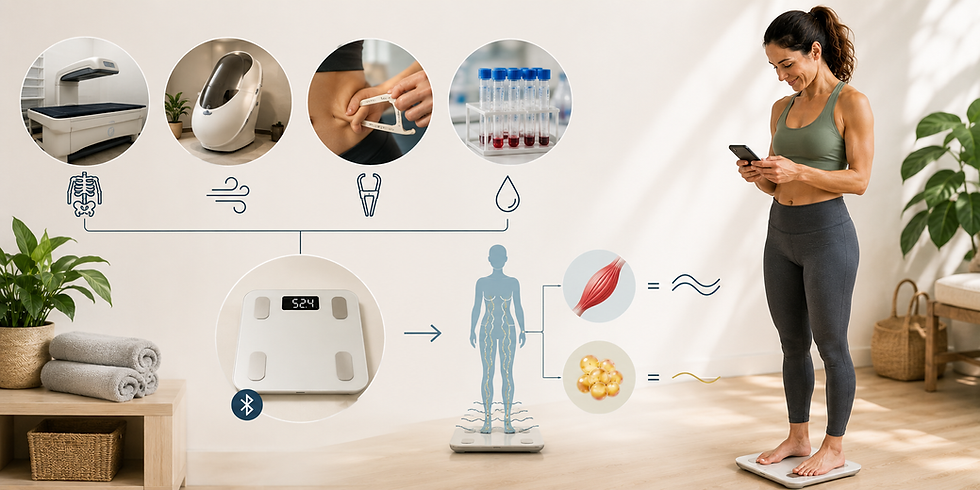
There are several ways to estimate body composition, and none of the convenient methods is perfectly precise.
DEXA scans use low-dose X-rays and can provide detailed information about bone mineral density and estimates of fat and lean tissue. Other methods include air-displacement testing, skinfold measurements and specialized laboratory techniques.
Then there are the devices many of us can use at home: smart body-composition scales.
These typically use a method called bioelectrical impedance analysis, or BIA.
When you stand on the scale, a very small electrical current travels through the body. Different tissues conduct that current differently. Because water-rich tissues such as muscle conduct electricity differently than fat tissue, the device can combine the electrical measurement with information such as your height, age and sex to estimate body composition.
It's clever technology—but the key word is estimate.
How Accurate Are Smart Scales?
This is where expectations matter.
A smart scale can give you considerably more information than a traditional scale, but the numbers shouldn't be treated as laboratory measurements.
Hydration, recent exercise, meals and other factors can affect bioelectrical impedance readings. Different devices also use different equations to calculate their estimates.
That doesn't make a smart scale useless.
It simply changes how you should use it.
Instead of becoming concerned because your body-fat percentage changed from one morning to the next, look for longer-term trends measured under similar conditions.
For example, if you choose to track body composition, you might measure yourself at roughly the same time of day and under similar circumstances. Over weeks and months, the direction of the trend may be more informative than any individual reading.
Think of a smart scale as a tool for spotting patterns—not as a device delivering a definitive report card on your body.
What Should You Pay Attention To?

If you're interested in improving body composition, you don't need to track every measurement available.
A few simple indicators can tell you quite a lot:
Changes in strength and what you're able to do
Trends in body weight or body composition over time
How your clothes fit
Waist circumference, if that's useful to you
Energy and exercise performance
Consistency with strength training, movement, sleep and nutrition
No single one of these tells the entire story.
Together, however, they can provide a much more complete picture than stepping on a scale and deciding whether the number was "good" or "bad."
What Actually Helps Improve Body Composition?
For most women, improving body composition doesn't require an extreme diet or spending hours at the gym.
Strength training is one of the most valuable tools because it gives your muscles a reason to adapt and become stronger. Progressive overload—gradually increasing the challenge placed on your muscles—helps continue that adaptation over time.
Protein also provides the amino acids needed to maintain and repair muscle tissue, while sufficient overall nutrition supports training, recovery and everyday life.
Regular movement matters too. Walking, recreational activities, cardio and simply being less sedentary all contribute to overall health.
And recovery shouldn't be overlooked. Sleep and rest help support exercise performance and the processes your body uses to repair and adapt.
None of these habits needs to be perfect to be worthwhile.
In fact, the most useful approach is usually the one you can continue consistently.
A Better Way to Think About the Numbers
Body-composition technology can be useful because it reminds us that our bodies are more complicated than one number on a bathroom scale.
But it can create another problem if we simply replace an obsession with weight with an obsession over body-fat percentage, muscle percentage or another metric.
The numbers are information.
They aren't a score.
If tracking body composition helps you understand your progress, it can be a valuable tool. If the numbers cause unnecessary stress or encourage you to judge normal daily fluctuations, you don't need them to build a strong, healthy body.
Your ability to carry something heavy, get up from the floor, walk comfortably, maintain balance, recover from exercise and continue doing the things you enjoy matters too.
Those changes may never appear on a smart scale.
The Bottom Line
Body composition gives us a more complete way to think about our bodies because it looks beyond total weight and considers what that weight represents.
For women in their 20s, 30s, 40s and 50s, understanding the difference between muscle, fat and overall weight can be particularly useful as exercise habits, hormones and life stages change.
You don't need to chase the lowest possible body-fat percentage or analyze every fluctuation on a smart scale.
Instead, use body-composition information for what it does best: helping you see the bigger picture.
Build and preserve muscle. Move regularly. Eat in a way that supports your body. Give yourself time to recover. Look for trends rather than daily perfection.
Because ultimately, a healthier body isn't defined by one number—it's supported by the things your body can do and the habits that help you keep doing them.
Continue Learning
Your weight doesn't tell the whole story about your health. Explore how smart scales estimate body composition, what their measurements can tell you, and why looking at trends over time may be more useful than focusing on individual numbers.
Not every health measurement deserves your attention. Discover which wellness metrics may provide useful insights, which ones can create unnecessary pressure, and how to approach tracking your progress with a balanced mindset.
Building and maintaining muscle is an important part of overall fitness. Learn how often to incorporate strength training, why recovery matters, and how to create a realistic routine that supports your long-term goals.


Comments